
 +86-592-5131 569
info@esep.co
Membrane Filtration at molecular level
Membrane filtration is a pressure driven technology with a selective thin, semi-permeable barrier that allows the solvent and some compounds or particles to pass through while restricting or retarding the passage of other compounds or particles, with pass-through determined by size and/or other properties of the compounds or particles.
A liquid consists of a number of components with different molecular or particle sizes. By using membranes with pores of different sizes, it is possible to separate exactly the components you wish to concentrate or remove from the liquid stream.
Membrane filtration is a straightforward technology that separates a liquid into two streams using a semi-permeable membrane.
A difference in pressure forces the components that are smaller than the membrane pores through the membrane as "permeate". The remaining components are retained as "retentate". A substantial flow moving parallel to the membrane prevents the membrane surface from getting blocked during the process. This is known as cross-flow filtration.
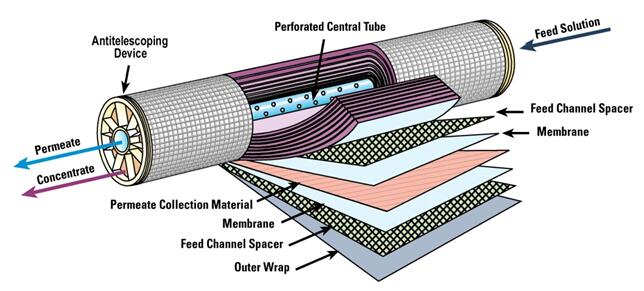
Spiral-Wound Membrane element Construction
Depending on the density of the membrane, the process is called reverse osmosis (RO), nanofiltration (NF), ultrafiltration (UF) or microfiltration (MF).
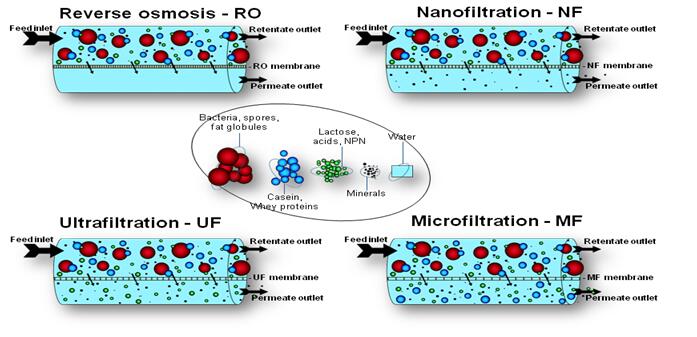
Principles of the four main membrane filtration technologies
Reverse osmosis (RO)
Reverse Osmosis(RO) is a high pressure-driven membrane filtration process which is based on a densest membrane type with the smallest pores. Strictly speaking, RO is not a size exclusion process based on pore size; it depends on ionic diffusion to affect separation. In principle, only water can pass through the membrane layer.
In principle, RO technology can be compared to evaporation, as both technologies remove water. However, RO uses pressure to remove the water from the product, whereas an evaporator uses heat to remove the water and therefore has a thermal impact on the product (mainly protein). Furthermore, both initial investment and operation costs are significantly lower for an RO plant than for an evaporator.
RO common applications are seawater desalination and pure water production, in which pure water is produced from a saline feed stream, similar to evaporation with far better economy.
RO is also used in product concentration, water reclamation, wastewater volume reduction, and other industrial processes, with the goal of producing a pure filtrate (typically water) or retaining the components.
Nanofiltration (NF)
Nanofiltration (NF) is a medium to high pressure-driven membrane filtration process. NF is a unique filtration process in-between UF and RO designed to achieve highly specific separation of low molecular weight compounds such as minerals and salts from complex process streams.
Generally, Nanofiltration (NF) is targeted to remove monovalent ions such as sodium, potassium and chloride which will pass through NF membrane, reject divalent, multivalent ions and higher molecular weight components. therefore many of its uses involve de-salting and concentration of the process stream.
Typical applications include de-ashing of dairy and food products, recovery of hydrolyzed proteins, concentration of sugars and purification of soluble dyes and pigments.
NF is also can be used for spent CIP detergent or acid & caustic solution (e.g. NaOH and HNO3) reclaim, in which case the permeate stream is purified acid or caustic.
Ultrafiltration (UF)
Ultrafiltration (UF) is a medium pressure-driven membrane filtration process. The UF membrane is a significantly more open membrane than the RO and the NF membranes. UF membranes are characterized by their molecular weight cut-off (MWCO). UF is a selective separation step used to both concentrate and purify medium to high molecular weight components such as plant and dairy proteins, carbohydrates, colloid and enzymes.
Common areas of UF application are protein concentration, gelatin de-ashing and concentration, clarification of fruit juices, electrocoat paint concentration and pharmaceutical purification.
Microfiltration (MF)
Microfiltration(MF) is a low pressure-driven membrane filtration process. The MF membrane is the most open membrane of the four membrane technologies. MF is used to separate large molecular weight suspended or colloidal compounds from dissolved solids.
The most common of MF application is the clarification of fermentation broths and purification processes in which macromolecules must be separated from other large molecules, proteins, or cell debris. Clarification of dextrose and fruit juices employ MF extremely well. There are also large markets for MF crossflow filtration in wine production, milk production, brewing, CIP chemical recovery.
Copyright @ 2020-2024 Xiamen eSep Membrane Technology Co., Ltd. +86-592-5131 569 info@esep.co 闽ICP备16003752号