
 +86-592-5131 569
info@esep.co
Focus on Technology Essence
Electrodialysis is an electrochemical separation process in which ions are transferred through ion exchange membranes from one solution to another by means of a DC voltage.
Electrodialysis is an electrically driven membrane separation process that is capable of separating, concentrating, and purifying selected ions from aqueous solutions (as well as some organic solvents). The process is based on the property of ion exchange membranes to selectively reject anions or cations. Electrodialysis can remove salts from food, dairy, and other products, waste streams and other solutions, as well as concentrate salts, acids or bases. The system is a useful tool to remove unwanted total dissolved solids that can build up in product streams.
The heart of the process is the electrodialysis stack (see schematic) consisting of alternating anion- and cation-exchange membranes separated by proprietary spacers (or gaskets). There are several circuits in the stack, such as feed (dilute) and brine (concentrate), thanks to channels formed by manifolds in membranes and spacers. The spacers direct the feed and brine solutions into the corresponding chambers and promote flow distribution. A set of two membranes and two spacers forms a cell or cell pair and hundreds of cells can be installed in one stack. A clamping system keeps the assembly together under a uniform closing pressure. The driving force is a direct current between anodes (positive electrodes) and cathodes (negative electrodes) housed at the two ends of the stack inside electrode plates.
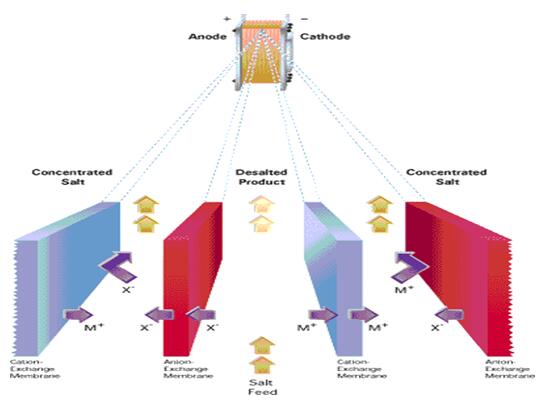
Schematic of ED stack
Careful design of the various components of the electrodialysis stacks can make a large difference in the overall performance of the system. For instance, good sealing is key to avoid physical leaks between the feed and brine solutions. This results in higher product purities and less wastes. An optimized netting geometry will insure that the solutions are well distributed in the entire cell and increase turbulence to reduce membrane surface phenomena and improve ion transport. The thickness of the spacers will affect the power consumption. We have developed a family of proprietary spacers that are tailored to various applications. The ion exchange membrane selection is also critical since selectivity will affect the purity of the product and the efficiency of the separation, their electric resistance will impact the power consumption, their chemical resistance will determine the compatibility and the feasibility of a given separation, etc.
ED is used in whey demineralization, lactose demineralization, demineralization of sugar and oligosaccharides, desalting of soy sauce and flavouring, purification of pharmaceutical products, tartaric stabilization of wine, organic desalting, amino acid desalting, desalination of sea water, desalination/concentration of waste salt solution and numerous other applications.
Copyright @ 2020-2024 Xiamen eSep Membrane Technology Co., Ltd. +86-592-5131 569 info@esep.co 闽ICP备16003752号